
See Reciprocal Influences website for general browsing of posts.
See also:


Continuing examination of William James’ essay, The Energies of Men,1 we can see that he implies that our energy, and the consequent feeling of aliveness, are usually at the mercy of every chance wind that blows. In a sentence that I have already quoted a couple of times, he says,
Every one knows on any given day that there are energies slumbering in him which the incitements of that day do not call forth, but which he might display if these were greater.
This is certainly a more old-fashioned use of the word incite than is usual today, with its roots of stirring, rousing and stimulating in a positive, self-motivating way. James also uses it in a similar way later. Indeed, “calling forth” is its hallmark.
James says of people in general,
He energizes below his maximum, and he behaves below his optimum.
He goes on to mention three means to “carry us over the dam” or “to push the barrier farther off,” namely, “Excitements, ideas, and efforts.”
Of the “excitements,” or stimuli for action that will summon these energies, he says,
The stimuli of those who successfully respond and undergo the transformation here, are duty, the example of others, and crowd-pressure and contagion.
In the posts, Before Calling Forth and Tamed With a Thread, I made use of the image of a dragon as representing these slumbering energies, something very powerful and which needs to be approached rightly. Knowing that there is a dragon that can come to one’s aid, given the right preparation and the right relationship, is something to fortify one’s efforts to gather one’s forces. This dragon I associate in particular with emotional energy, and, likewise, James draws particular attention to the emotions as being what can drive us beyond our ordinary limitations. He says,
…the stimuli that carry us over the usually effective dam are most often the classic emotional ones, love, anger, crowd-contagion or despair.
It is evident that the most effective and most necessary of these stimuli are connected with other people. As ever, we need each other’s help in order to live at our highest level. Love and anger, taken in an ordinary sense, can each go either way, however, in constructive or destructive action, but like any of the emotions, can be used for their motivating power. But certainly we need to protect ourselves from vulnerability to the destructiveness of “crowd-contagion.” Our “self-incitements” to access energy for fuller living need also the stabilising influence of its opposite partner, rationality, and of self-questioning. James’ mention of despair is striking. He points out that “Despair lames most people, but it wakes others fully up.”
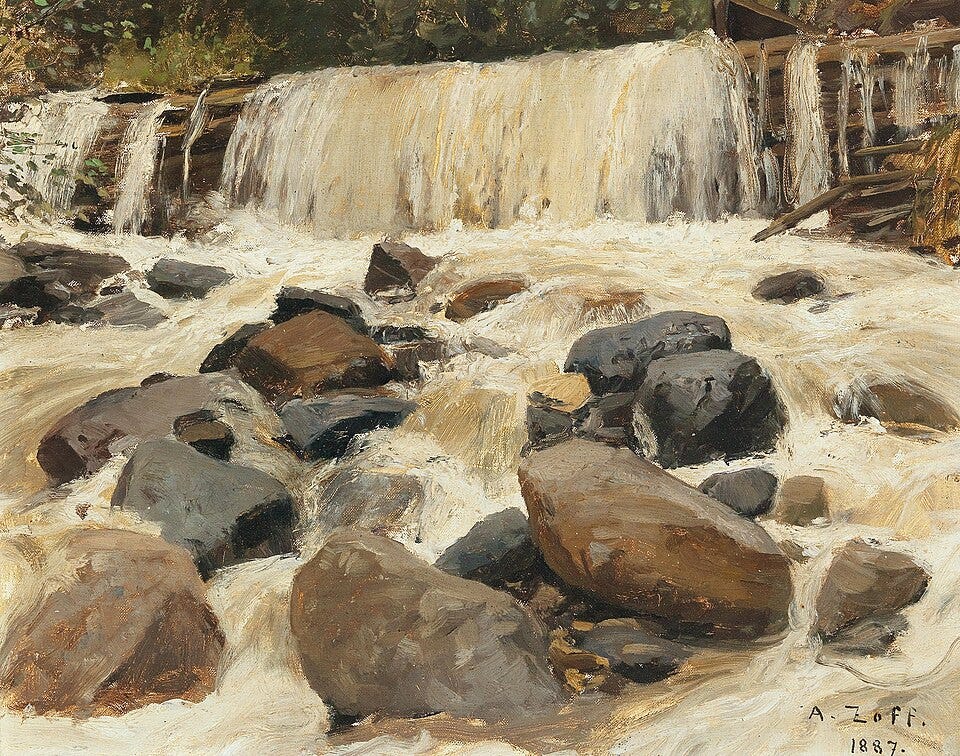
The dam is an interesting metaphor, recalling somewhat Mesmer’s frequent description of a vital flow being obstructed in illness.2 And if we are not functioning at the higher energetic level that we could be, is that perhaps not a kind of illness, this “the habit of inferiority to our full self,” as James calls it?
James also mentions ideas. An idea, too, can be an inciter of energy and action, but ideas are truly evocative of the needed motivation from emotion only if they are associated with picturings, not just words.
There is also the important aspect of using small actions to grease the wheels of larger actions. And in speaking of that often seemingly inaccessible something, the will, James also includes being opportunistic, and riding on the back of chance, as it were.
The normal opener of deeper and deeper levels of energy is the will. The difficulty is to use it, to make the effort which the word volition implies. But if we do make it (or if a god, though he were only the god Chance, makes it through us), it will act dynamogenically on us for a month. It is notorious that a single successful effort of moral volition, such as saying “no” to some habitual temptation, or performing some courageous act, will launch a man on a higher level of energy for days and weeks, will give him a new range of power.
I must use help from every quarter in “stirring up” the latent energies that are my birthright, yet so often are unused.
William James - The Energies of Men, Moffat, Yard & Company (New York), 1914.
E.g., F.A. Mesmer - Allgemeine Erläuterungen über den Magnetismus und den Somnambulismus [General Explanations of Magnetism and Somnambulism], (ed. Wolfart, K.C.), Hallischen Waisenhaus (Halle and Berlin), 1812, p.35; and Mesmerismus. Oder System der Wechselwirkungen, Theorie und Anwendung des thierischen Magnetismus als die allgemeine Heilkunde zur Erhaltung des Menschen [Mesmerismus. Or System of Reciprocal Influences, Theory and Application of Animal Magnetism as the Universal Science of Healing for the Preservation of Humanity], (ed. Wolfart, K.C.), Nikolai (Berlin), 1814, p.171.