
To Many a Well
The importance of everyday suggestion.
See Reciprocal Influences website for browsing of posts.
Related:

,_by_Henry_Herbert_La_Thangue.jpg)
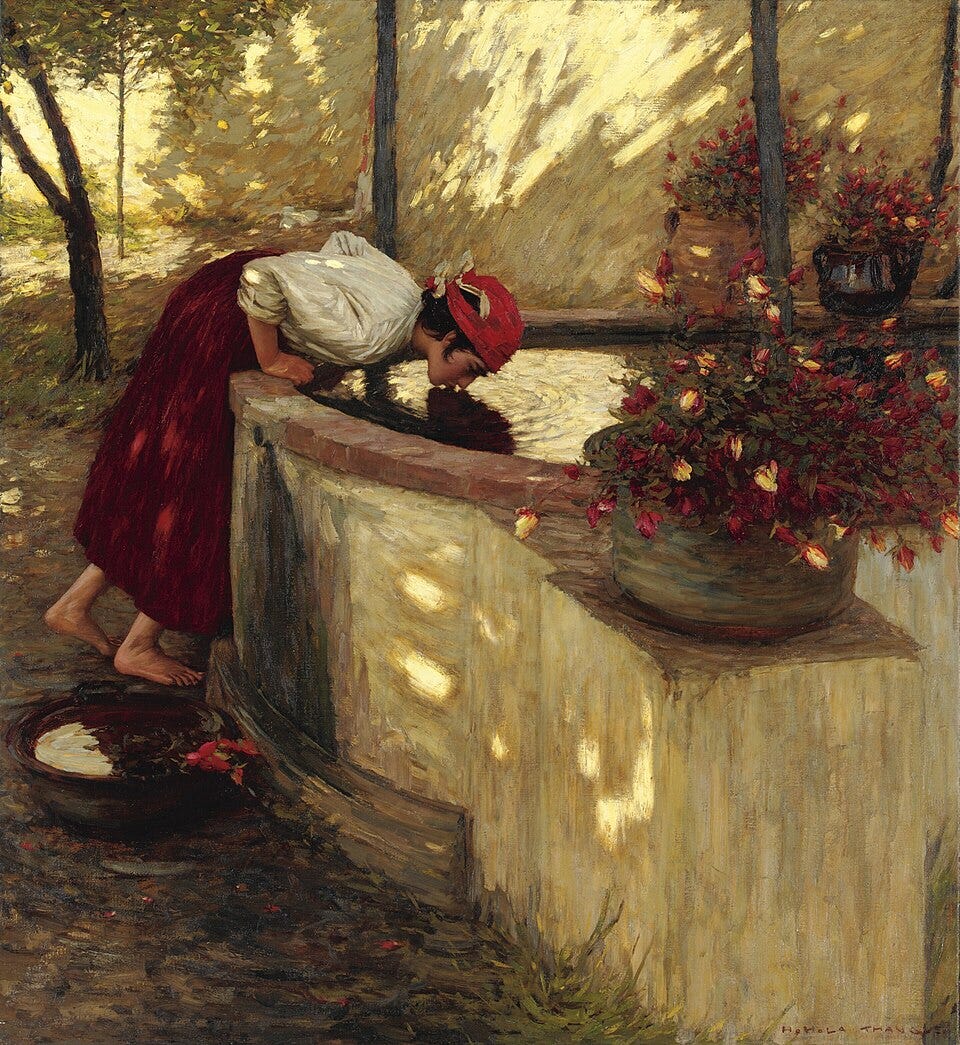
To many a well have y go: to fynde watter to wash me fro woe.
From a fifteenth century English carol.1
…all shall be well, and all shall be well, and all manner of thing shall be well.
Julian of Norwich (c.1343– after 1416)2
“Well” is an interesting word. It can be a question all by itself - Well? . . . It may also be a deep hole dug for drinking water. And how many fairy tales and the like have something like a well in them? “Well” may indicate health, or a perception of well-being. "All's well" signifies things are all right, that is, all good. “Ah well,” makes the best of things; and “well” as an adverb, as in well done, well-made, well-kept, may suggest some kind of completeness, as in wholeness, as well as being done in a good way. Although the words “well” and “whole” have different roots, there is a strangely fortuitous conjunction of their sound and meaning, and the resonances between derived words, weal, wealth, health. There is possibly a link between the roots of well and will and wish, which is worth adding to the cooking pot of ponderings.3
One can take one use of the word “well” as part of a self-suggestive practice containing much benefit. Bearing in mind the many automatisms often inherent in the common convention of asking “How are you?,” the question is, nevertheless, sometimes asked with a real wish to know, and to connect with that person. However superficial the response might be, it seems to me something to take seriously, as the suggestive consequences are very real, for both questioner and listener. And, of course, the question is usually exchanged.
To answer, “I am well,” while putting one’s attention on this wellness, coursing through the body, as it were, evokes a sensation of well-being, and can initiate a current of wellness, you could say. It is rather in the vein of Émile Coué’s famous saying, “Every day, in every way, I am getting better and better”4 - evoking and concentrating, and thus enlarging, even the smallest of pleasant and beneficent sensations and emotions, so that more and more suggestive medicine is made, to produce a fertile psychological ground for Nature to work her wisdom, and magic.
This is all very well, I hear some say, but what if you’re not feeling great, and someone asks, How are you? One could, indeed, do as above, and use an untruth to reach, by creating, a truth - namely, “I am well.” Or, using a less definitive word, such as in, “I am grand.” Or, even, as long as it is not tossed off any old how, “I am fine.” The key is to experience its meaning while sounding the words, and letting the echoes of that evoked state reverberate in one’s body and being.
But if one must complain, well this too must be done well. Again, using the sound of the words, always steering clear of negativity, to pronounce, in no uncertain terms, and even compel the forcefulness of, the characteristics of one’s state. This is no excuse for whimpering and apologetic moans. On the contrary, bring on the full experience. Intensify the process. No better demonstration could be given than a recitation of Robbie Burns’ Address to the Toothache,5 with all the actions, whose first verse is as follows:
My curse upon your venom’d stang,
That shoots my tortur’d gooms alang,
An’ thro’ my lug gies monie a twang
Wi’ gnawing vengeance,
Tearing my nerves wi’ bitter pang,
Like racking engines!
Yet, one could go further, and dare it to do its worst!
Then what about the scenario of experiencing a new and unknown symptom? How easy it is, especially if alone, and at night, and if other things in life have conspired for a period to make you more sensitive and nervous, to unconsciously blow things out of proportion. Fear is a great magnifier. You are, in short, in a state ripe for hypnosis, namely, very suggestible. Well, instead of being a slave to this suggestibility, submitting to the common occurrence of experiencing things in a unintentionally distorting and intensifying mirror, because of focussing of fears, and “what if?”, enlarging the negatives, one can always turn things around and use this suggestibility. It is no good just trying to squash it, because, willy nilly, part of our nature is like that, no matter how cold and rational the intellectual part may be.
For instance, one can use the energy automatically roused, in feeding a scientific curiosity, a thirst for understanding more about one’s body and mind, an interest in what is occurring. One can say to oneself, “How interesting that this is happening; I wonder how things will unfold.”
All in all, it is of abiding interest and utility, and a reason for gratitude, that physiology and psychology are so connected. However, I myself need to relinquish the automatic chains of negativity that can so easily imprison, and to be open to the life- and health-giving waters of that mysterious well, whose fountains and streams penetrate likely and unlikely places, inside and outside of me, that I may “find water to wash me from woe.”
Anonymous carol, c.1500, in MS 5665, Ritson Manuscript (ff.46v-47), British Library, London. Can be found in Mediæval Carols, ed. John Stevens, Musica Britannica, Stainer and Bell (London), 1970, p.104.
REVELATIONS of DIVINE LOVE. Recorded by JULIAN, Anchoress at NORWICH. ANNO DOMINI 1373. A version from the MS. in the BRITISH MUSEUM edited by GRACE WARRACK, Methuen & Company (London), 1901, p.56.
Émile Coué - Self-Mastery Through Conscious Autosuggestion, tr. A.S. van Orden, Malkan Publishing Co. (New York), 1922, p.43.
This can be found in The Complete Poetical Works of Robert Burns, Houghton Mifflin Country (Boston and New York), 1912, p.118.